


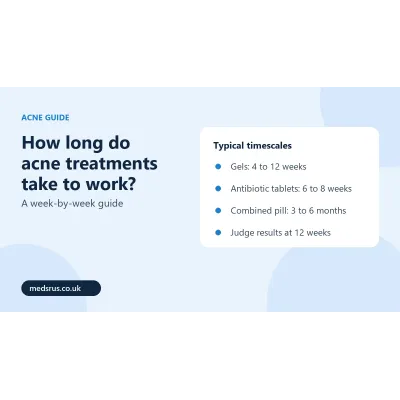
One of the most common reasons acne treatment fails is that people stop too soon. Gels, creams and tablets all work by changing what happens inside the pore, and new spots take weeks to form. That means it takes weeks, not days, before you see a difference.
Here's a realistic timeline, and what to do if your skin isn't improving.
The short answer
Most acne treatments take six to eight weeks before you notice an improvement. UK guidance from NICE recommends using a treatment for 12 weeks before judging whether it has worked. Improvement usually continues after that.
What to expect week by week
Weeks 1 to 4
You may not see much change in the number of spots. With retinoid gels (adapalene or tretinoin) and benzoyl peroxide, it's common to have dryness, redness, stinging or peeling in the first few weeks. Some people notice a few more spots at first, as blocked pores come to the surface. This usually settles as the skin gets used to the treatment.
Weeks 4 to 8
Inflamed spots usually start to calm down, and fewer new ones appear. Irritation often eases. If you're taking an antibiotic tablet such as lymecycline, this is often when red, tender spots start to improve.
Weeks 8 to 12
By now there's usually a clear difference. Your prescriber or GP will normally review your progress at around 12 weeks to decide whether to continue, change or step down treatment.
After 12 weeks
If your skin has cleared or nearly cleared, the next step is usually maintenance. Acne tends to come back if treatment stops completely, so many people carry on with a topical treatment such as adapalene, or a combination of adapalene and benzoyl peroxide, a few times a week or daily. Antibiotic tablets are not used for maintenance.
Typical timescales by treatment
| Treatment | When most people notice a change | Points to know |
|---|---|---|
| Benzoyl peroxide (alone or combined) | 4 to 8 weeks | Can bleach towels, clothes and hair |
| Retinoid gels (adapalene, tretinoin) | 6 to 12 weeks | Irritation is common early on; not for use in pregnancy |
| Azelaic acid | 6 to 8 weeks | Usually well tolerated; can help dark marks |
| Antibiotic tablets (lymecycline, doxycycline) | 6 to 8 weeks | Always used with a gel or cream, usually for no more than 6 months |
| Combined contraceptive pill | 3 to 6 months | Only suitable for some women, after a health check |
How to get the best results
- Use it every day as directed. Skipping days slows progress.
- Treat the whole area, not just individual spots. Gels work by preventing new spots as well as treating existing ones.
- Start gently. If your skin is irritated, a prescriber may suggest using the gel every other day at first, or washing it off after a shorter time, then building up.
- Moisturise. A light, non-comedogenic moisturiser helps with dryness and makes it easier to keep going.
- Use sunscreen. Retinoids and some antibiotics can make skin more sensitive to sunlight.
When to go back to your prescriber or GP
Get advice if:
- there's no improvement after 12 weeks of using a treatment properly
- irritation is severe, or you develop swelling, blistering or a rash
- your acne is leaving scars or dark marks, or is affecting your mood or confidence
- you become pregnant or are planning a pregnancy while using a retinoid or a tetracycline
If two different treatments haven't worked, or your acne is severe, your GP can refer you to a dermatologist. To see the treatments we offer, visit our acne treatment page. You may also find our guides to hormonal acne and lymecycline useful.
Frequently asked questions
Why is my acne worse after starting treatment?
Some treatments, especially retinoid gels, can bring blocked pores to the surface and irritate the skin in the first few weeks. This usually settles. If your skin is very sore, blistered or swollen, stop and ask a pharmacist, prescriber or GP for advice.
How long should I try an acne treatment before switching?
UK guidance suggests 12 weeks. Switching earlier often means you never find out whether a treatment would have worked.
Will my acne come back when I stop treatment?
It can. Acne often returns if treatment stops completely, so many people continue with a topical treatment for maintenance once their skin is clear. Your prescriber can advise on the best option for you.
Can I speed up acne treatment by using more?
No. Applying more gel or using several products at once tends to cause more irritation without clearing spots faster. A thin layer once a day, or as directed, is usually enough.
Sources: