


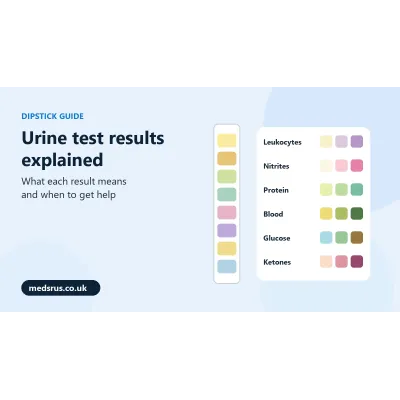
A urine dipstick test is one of the quickest checks in healthcare. You give a sample, a strip is dipped in it, and coloured pads change shade within a minute or two. But the results often come back as a list of unfamiliar words and plus signs, with little explanation.
This guide explains what each result on a standard dipstick means, what's usually considered normal, and when a result needs follow-up.
How a urine dipstick works
A dipstick is a plastic strip with a row of small chemical pads. Each pad reacts to a different substance in your urine and changes colour depending on how much is there. The colour is compared with a chart, or read by a machine, and reported as negative, trace, or one to three or four plus signs (+, ++, +++).
A dipstick is a screening test. It can point towards a problem, but it can't confirm one on its own. A positive result is often followed by a lab test, or interpreted alongside your symptoms.
Each result explained
Leukocytes (white blood cells)
Normal: negative.
White blood cells are part of your immune system, and they gather where there's infection or inflammation. A positive leukocyte result most often points to a urinary tract infection (UTI), but it can also appear with other causes of inflammation. Our in-depth guide to white blood cells in urine covers the causes in detail.
Nitrites
Normal: negative.
Many of the bacteria that cause UTIs turn nitrates, which are normally in urine, into nitrites. A positive nitrite result is a fairly strong sign of a bacterial infection, especially alongside positive leukocytes. A negative result doesn't rule infection out, though. Not all bacteria produce nitrites, and urine needs to sit in the bladder for a few hours for them to build up.
Blood (haematuria)
Normal: negative.
Blood can come from anywhere in the urinary tract. Common, usually harmless causes include infection, a period, or very strenuous exercise. Less often it can be a sign of kidney stones or a condition that needs investigating. Always see a GP about blood in your urine, whether you can see it or it's only found on a test, unless it's clearly explained by a period or an infection that has been treated and a repeat test is clear.
Protein
Normal: negative or trace.
Healthy kidneys keep most protein in the blood. A small amount can appear temporarily after exercise, during a fever, or with dehydration. Protein that keeps showing up on repeat tests can be an early sign that the kidneys aren't filtering properly, often linked to diabetes or high blood pressure, and your GP may arrange a lab test to measure it accurately.
Glucose (sugar)
Normal: negative.
Glucose usually only spills into urine when blood sugar is high. A positive result can be a sign of diabetes, or of diabetes that isn't well controlled, so it should be followed up with a GP. Some diabetes medicines deliberately cause glucose in the urine; if you take one, tell whoever is testing you.
Ketones
Normal: negative.
Ketones are made when the body burns fat for energy instead of sugar. Small amounts are common if you're fasting, following a very low-carb diet, or have been vomiting. In someone with diabetes, ketones alongside high blood sugar can be a sign of diabetic ketoacidosis, a medical emergency. If you have diabetes and find ketones, follow your sick-day plan and get urgent help if you feel unwell, are vomiting, or are breathing fast.
Specific gravity
This measures how concentrated your urine is. A high reading usually just means you haven't drunk much. Persistently unusual readings can be worth discussing with a GP, but on their own they're rarely a cause for concern. Not drinking enough can also play a part in infections; see can dehydration cause a UTI?
pH
This shows how acidic or alkaline your urine is. It varies with diet, and a single reading rarely means much. It's mainly useful alongside other results, for example in people prone to certain types of kidney stones.
Bilirubin and urobilinogen
These relate to how the liver processes old red blood cells. Bilirubin is normally negative and urobilinogen normally low. An abnormal result can point to a liver or gallbladder problem and should be checked by a GP, especially if you also notice yellowing of the skin or eyes, or dark urine with pale stools.
Results that often go together
- Leukocytes and nitrites both positive, with burning when you pee: a urinary tract infection is likely.
- Leukocytes positive, nitrites negative: infection is still possible, but other causes of inflammation should be considered.
- Blood and leukocytes positive with UTI symptoms: often an infection. A repeat test after treatment should be clear; if blood remains, see a GP.
- Glucose and ketones both positive: needs prompt medical advice, and is urgent if you have diabetes and feel unwell.
What if you have UTI symptoms?
Typical UTI symptoms include burning or pain when you pee, needing to go more often or more urgently, cloudy or strong-smelling urine, and lower tummy pain. Women aged 16 to 64 who aren't pregnant or breastfeeding can often be treated by a pharmacist; see our cystitis and UTI treatment. Our guide to cystitis vs UTI explains the difference between the two terms.
According to the NHS, ask for an urgent GP appointment or call NHS 111 if:
- you're a man, are pregnant, or are aged 65 or over
- you have a high or very low temperature, or feel hot and shivery
- you have pain in your back, just under the ribs, which can be a sign of a kidney infection (see kidney infection vs UTI symptoms)
- you can see blood in your urine
- your symptoms get worse, or don't improve within 48 hours of starting treatment
- you keep getting UTIs (2 within 6 months, or 3 within 12 months)
Call 999 or go to A&E if someone with a UTI becomes confused, drowsy or has difficulty speaking.
Getting the most accurate result
- Use a clean container, and collect a midstream sample: start peeing into the toilet, then catch the middle part.
- Early-morning urine is the most concentrated, which makes some results more reliable.
- Test the sample within an hour or two, or keep it in the fridge if it's going to a surgery.
- Tell the person testing you if you're on your period, as this can cause a false positive for blood.
Frequently asked questions
What does "trace" mean on a urine test?
A very small amount was detected, at the bottom of the scale. Trace protein or blood is often temporary, and your GP may simply repeat the test.
Can a urine dipstick test be wrong?
Yes. Dipsticks are screening tools. They can miss infections (false negatives) or show results that aren't significant (false positives). They're less reliable in people over 65, who often have bacteria in their urine without an infection, which is why results are always interpreted alongside symptoms.
Does a positive nitrite test always mean a UTI?
It strongly suggests bacteria in the urine, but it's interpreted alongside symptoms. If you have no symptoms, a positive result may not need treatment, especially in older adults.
Should I be worried about protein in my urine?
A one-off trace is common and often harmless. Protein that shows up repeatedly should be checked by a GP, particularly if you have diabetes or high blood pressure.
Can I test my urine at home?
Yes, home dipstick kits are widely available. They're useful for spotting a likely UTI, but see a pharmacist or GP to confirm the cause and get the right treatment, and always get unexplained blood, glucose or protein checked.