


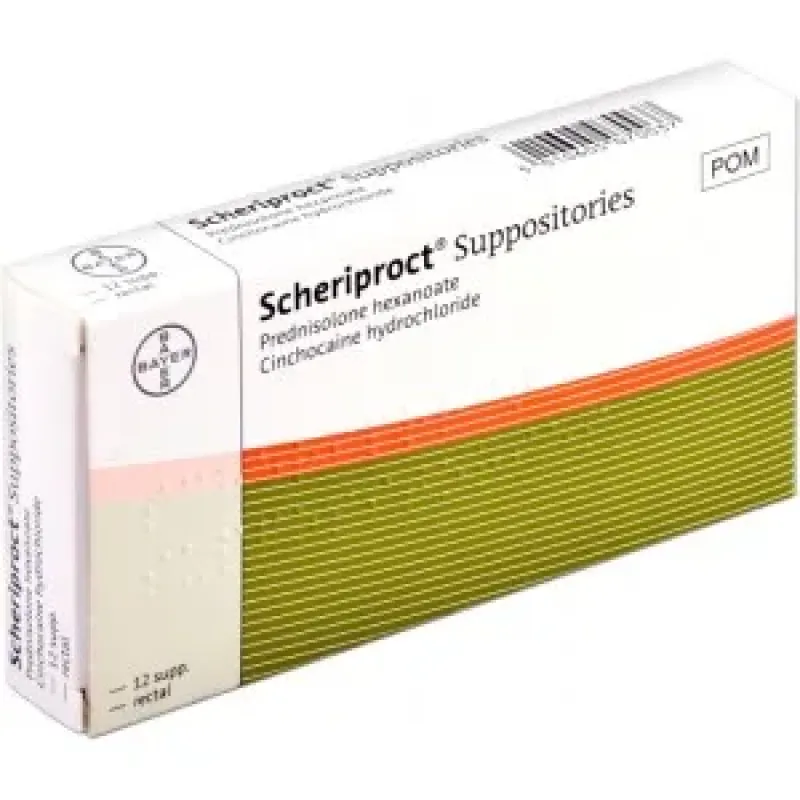
Images are for illustration only.
Scheriproct Suppositories
Scheriproct suppositories contain a mild steroid (prednisolone) and a local anaesthetic (cinchocaine) to ease the pain and swelling of internal piles. Usually one a day, after a bowel movement, for up to 7 days.
Free online assessment with a UK prescriber



Scheriproct suppositories are a prescription treatment for internal piles (haemorrhoids). Each suppository contains a mild steroid, prednisolone, to reduce swelling, and a local anaesthetic, cinchocaine, to numb the pain. They're usually used once a day, after a bowel movement, for up to 7 days. A UK prescriber reviews a short online consultation before supplying them, and we send them in plain packaging.
Scheriproct suppositories at a glance
| Details | |
|---|---|
| Active ingredients | Prednisolone hexanoate (a steroid) and cinchocaine hydrochloride (a local anaesthetic) |
| Used for | Pain and swelling from internal piles |
| How often | Usually one a day, after a bowel movement |
| How long | Up to 7 days |
| Pack | 12 suppositories |
| Prescription needed | Yes |
How do Scheriproct suppositories work?
- Prednisolone is a mild corticosteroid. It calms the inflammation that makes piles swollen and sore.
- Cinchocaine is a local anaesthetic. It numbs the area for a while, easing pain and discomfort.
The suppository melts inside the back passage, releasing the medicine where internal piles are.
How to use Scheriproct suppositories
- If you can, empty your bowels first.
- Wash your hands, then gently clean and dry the area around your bottom.
- Tear one suppository off the strip and remove its wrapper.
- Lie on your side with your knees drawn up, and gently push the suppository into your back passage as far as is comfortable.
- Stay lying down for a few minutes, then wash your hands again.
Use one suppository a day, after a bowel movement. If your symptoms are severe, the prescriber may advise 2 to 3 a day for the first few days. Don't use them for more than 7 days unless a doctor tells you to. If your symptoms haven't improved after 7 days, see a GP.
Suppository or ointment?
Suppositories are for internal piles only. Scheriproct ointment works for external piles and, with its nozzle, internal ones too. Some people use both. Proctosedyl ointment is a similar option with a different mild steroid (hydrocortisone). Our page on haemorrhoid treatment compares them, and has tips on easing piles and stopping them coming back.
Side effects of Scheriproct
Most people have no side effects with a short course. Some notice mild irritation or burning in the area. Using it for longer than recommended can thin the skin.
Stop using it and get advice if you get a rash, more pain, or signs of an allergic reaction.
Who shouldn't use Scheriproct?
Don't use Scheriproct if you:
- have an infection in or around your bottom, for example thrush, herpes or another skin infection;
- are allergic to any of its ingredients, or to other local anaesthetics.
Speak to a GP or pharmacist first if you're pregnant, especially in the first 3 months, or breastfeeding, and tell the prescriber about any other medicines you use.
When to see a GP
Piles are the most common cause of bright red blood on the toilet paper, but bleeding can sometimes mean something more serious. See a GP if:
- the blood is dark, or mixed into your poo;
- your bowel habits have changed for 3 weeks or more;
- you've lost weight without trying;
- your symptoms haven't improved after 7 days of treatment.
Go to A&E if you're bleeding heavily or the bleeding won't stop.
How to get Scheriproct from MedsRus
- Complete a short, confidential consultation about your symptoms and your health.
- A UK prescriber reviews it and, if suitable, approves your treatment.
- We send it in plain, discreet packaging.
Scheriproct suppositories FAQs
How do I insert a Scheriproct suppository?
Wash your hands, take one suppository out of its wrapper, and gently push it into your back passage as far as is comfortable. Lying on your side with your knees drawn up can make this easier. Wash your hands again afterwards.
How many suppositories can I use a day?
Usually one a day, after a bowel movement. If your symptoms are severe, the prescriber may advise 2 to 3 a day for the first few days. Don't use them for more than 7 days.
Suppository or ointment: which is better?
Suppositories are for internal piles. The ointment works for external piles and, with its nozzle, internal ones too. Some people use both. The prescriber will suggest what suits your symptoms.
Can I use Scheriproct while pregnant?
Speak to a GP or pharmacist first if you're pregnant, especially in the first 3 months, or if you're breastfeeding.
How long does Scheriproct take to work?
The anaesthetic eases pain quickly, and most people notice the swelling improve within a few days. See a GP if you're no better after 7 days.
Further reading
Sources: