


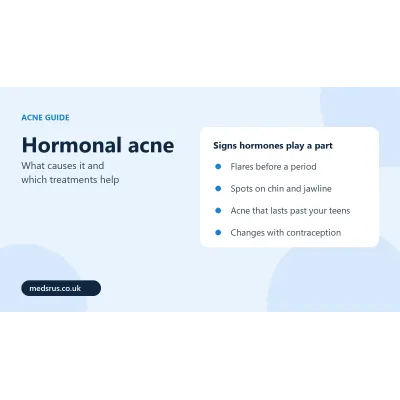
"Hormonal acne" isn't a separate medical diagnosis, but it's a useful way to describe a pattern many people recognise: spots that flare before a period, that carry on into your 20s, 30s or 40s, or that sit mainly around the chin and jawline. Hormones play a part in almost all acne, so the good news is that the same proven treatments work here too.
This guide explains how hormones affect your skin, the patterns that point towards a hormonal trigger, and the treatment options a prescriber may suggest.
How hormones cause spots
Acne starts in the hair follicles. Androgens (hormones such as testosterone, which everyone makes in different amounts) make the oil glands in the skin bigger and more active. Extra oil, together with dead skin cells, can block the follicle. Bacteria that normally live on the skin then multiply in the blocked pore, which leads to inflammation, redness and pus.
The skin's sensitivity to androgens is partly inherited. That's why two people with similar hormone levels can have very different skin, and why acne often runs in families.
Signs that hormones are playing a part
- Flares linked to your cycle: spots that appear or worsen in the week or so before a period.
- Adult acne: acne that continues past your teens or starts for the first time in adulthood. It's more common in women.
- Where the spots are: mainly on the lower face, chin, jawline and neck, often as tender, deeper spots rather than lots of blackheads.
- Life changes: acne that changes after starting, stopping or switching contraception, during pregnancy, or around the menopause.
These patterns are common and usually nothing to worry about. Occasionally, acne is part of a wider hormonal condition.
PCOS and other hormonal conditions
Polycystic ovary syndrome (PCOS), which the NHS now calls polyendocrine metabolic ovarian syndrome (PMOS), is a common condition that can cause irregular or missed periods, excess hair on the face or body, thinning hair on the scalp, weight gain and acne. If you have acne together with any of these, it's worth seeing a GP, who can arrange blood tests and look at the whole picture. The NHS guide to PCOS (PMOS) explains the symptoms in more detail, and our article on early signs of pregnancy with PCOS covers PCOS and fertility.
See a GP too if acne appears suddenly in adulthood alongside other new symptoms, such as a deeper voice or rapid hair growth, as these need checking.
Treatments that help hormonal acne
UK guidance from NICE doesn't treat hormonal acne differently from other acne. The choice depends mainly on how severe it is, your skin type, and whether you could become pregnant.
Topical treatments (gels and creams)
For most people, the first step is a 12-week course of a combination gel applied once a day. Options include adapalene with benzoyl peroxide, clindamycin with benzoyl peroxide, or tretinoin with clindamycin. Azelaic acid is a gentler option for sensitive skin and can also help fade dark marks. Retinoid gels such as adapalene and tretinoin should not be used in pregnancy or if you're trying to conceive.
Antibiotic tablets
For moderate to severe acne, a prescriber may add a tetracycline antibiotic, such as lymecycline or doxycycline, alongside a topical treatment. Tablets are never used on their own, and a course is usually reviewed at 12 weeks and kept to six months or less where possible. Our guide to lymecycline for acne explains what to expect.
The combined contraceptive pill
For women who also want contraception, a combined pill can reduce acne over a few months by lowering the effect of androgens on the skin. NICE suggests it can be used together with a topical treatment. It isn't suitable for everyone, so a prescriber will check your blood pressure, weight, smoking status and medical history first. Progestogen-only pills don't improve acne and can sometimes make it worse. You can read more about the options in our contraception section.
Specialist treatments
If acne is severe, leaving scars, or hasn't improved after two courses of treatment, a GP can refer you to a dermatologist. Specialist options include isotretinoin and, for some women, other hormonal treatments. These are only started under specialist care.
Everyday habits that help
- Wash the affected skin twice a day with a gentle, fragrance-free cleanser and lukewarm water. Scrubbing harder doesn't help.
- Choose make-up, sunscreen and moisturisers labelled non-comedogenic.
- Try not to squeeze or pick spots, as this increases the risk of scarring.
- Give any treatment time. Most take six to eight weeks before you notice a change; see how long acne treatment takes to work.
If you'd like a prescriber to look at your skin, our acne treatment page explains the options we offer and how the online consultation works.
Frequently asked questions
Is hormonal acne different from normal acne?
Not in how it develops. Hormones affect oil production in all acne. The term usually describes adult acne, flares linked to periods, or spots around the chin and jaw. It is treated with the same proven medicines.
Does the contraceptive pill help acne?
A combined pill can improve acne in women over a few months and may be used alongside a gel or cream. It isn't right for everyone, so a prescriber checks your health first. Progestogen-only pills don't help acne and can sometimes make it worse.
Can diet cause hormonal acne?
The evidence is limited. Some people notice a link with certain foods, but no specific diet is recommended for acne in UK guidance. A balanced diet is sensible, and it's better to use a proven treatment than to cut out whole food groups.
When should I see a GP about hormonal acne?
See a GP if your acne is severe, leaving scars, affecting your mood, or hasn't improved after treatment. You should also see a GP if acne comes with irregular periods, excess hair growth or other new symptoms, as these can point to a condition such as PCOS.
Sources: