


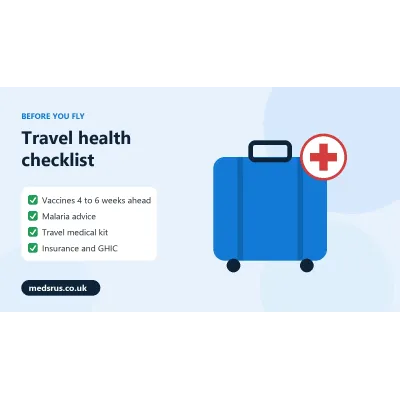
Most travel health problems are preventable with a little planning. The trouble is that the things that matter most, such as vaccines and malaria tablets, need to be arranged weeks before you fly, not the night before.
Use this checklist to work through what you need, from the moment you book to the week after you get home.
As soon as you book: 4 to 6 weeks before you travel
The UK's National Travel Health Network and Centre (NaTHNaC) advises booking a travel health appointment ideally at least 4 to 6 weeks before you travel. Some vaccines need more than one dose, and some malaria tablets have to be started before you leave. If you're travelling at short notice, a last-minute appointment is still worth having.
- Check your destination. Look up your country on TravelHealthPro to see the recommended vaccines, the malaria risk and any current outbreaks.
- Vaccines. Some travel vaccines are free from your GP surgery. Others, including yellow fever, rabies and Japanese encephalitis, are only available privately. Take a record of any previous vaccines to your appointment.
- Malaria. If you're going somewhere with malaria risk, ask about antimalarial tablets. Different tablets suit different destinations and health conditions, and they have different start dates. Read more in our guide to malaria tablets.
- Existing conditions. If you have diabetes, a heart or lung condition, are pregnant or have a weakened immune system, get advice early. Some destinations and medicines need extra care.
- Insurance. Buy travel insurance when you book, and declare any medical conditions. For trips to the EU, apply for a free Global Health Insurance Card (GHIC) on the NHS website. It's not a substitute for insurance.
Two weeks before: medicines and paperwork
- Order repeat medicines so you have enough for the trip plus a few spare days in case of delays.
- Check the rules for taking medicines abroad. Some countries restrict medicines that are routine in the UK, including some strong painkillers and sleeping tablets. Check with the embassy of the country you're visiting. If you carry a controlled medicine, you may need a letter from your prescriber.
- Keep medicines in their original packaging with the pharmacy label, and pack them in your hand luggage.
- Altitude. If you're travelling above about 2,500 metres, for example trekking in the Andes, the Himalayas or Kilimanjaro, plan a gradual ascent and ask whether preventive tablets suit you. See our guide to altitude sickness tablets.
Your travel medical kit
A small kit saves a lot of hassle hunting for a pharmacy abroad:
- Your regular medicines, plus copies of your prescriptions
- Paracetamol and/or ibuprofen
- Oral rehydration sachets for diarrhoea and vomiting
- Anti-diarrhoea tablets for short-term relief (not for children, or if you have a high temperature or blood in your stools)
- Antihistamine tablets for allergies, bites and itching
- Insect repellent containing DEET (around 50% is recommended for high-risk areas), and a mosquito net if your accommodation doesn't provide one
- Sunscreen, SPF 30 or higher with at least 4-star UVA protection, plus after-sun
- Plasters, blister plasters, antiseptic wipes and a small bandage
- Travel sickness remedies if you get sick on boats, coaches or winding roads
- Hand sanitiser
- A digital thermometer
You can find many of these in our travel health range, including travel sickness treatments.
On the journey
Long flights
Sitting still for a long time slightly raises the risk of a blood clot in the leg (deep vein thrombosis, DVT). On flights over about 4 hours:
- Walk around the cabin when you can, and flex your ankles and calves while seated.
- Drink plenty of water, and go easy on alcohol.
- Wear loose, comfortable clothing.
- If you've had a clot before, recently had surgery, are pregnant or have other risk factors, ask a pharmacist or GP whether flight socks are right for you.
Jet lag
Switch to local time as soon as you arrive, get out into daylight, and try to stay awake until a normal local bedtime. Flying east is usually harder than flying west. Our article on managing jet lag explains more.
Travel sickness
Sit where there's least movement: over the wing on a plane, at the front of a coach, in the middle of a ship. Look at the horizon rather than a screen. Medicines work best taken before the journey starts.
While you're away
- Avoid insect bites. NaTHNaC advises using repellent, covering up and sleeping under a net in risk areas. Malaria mosquitoes mainly bite between dusk and dawn; dengue mosquitoes bite during the day.
- Food and water. Where tap water isn't safe, drink bottled or treated water and avoid ice. Eat food that's freshly cooked and served hot, and peel your own fruit.
- Sun safety. Reapply sunscreen regularly and after swimming, and keep out of the strongest sun around midday.
- Animals. Avoid touching dogs, cats and monkeys. If you're bitten or scratched where rabies is a risk, wash the wound with soap and water for 15 minutes and get medical help the same day.
- Diarrhoea. Most travellers' diarrhoea settles in a few days. Keep drinking, use rehydration sachets, and get medical help if you have a high temperature, blood in your stools, or it lasts more than a few days.
After you get home
- Finish your malaria tablets. Some types must be continued for up to 4 weeks after you leave a risk area.
- A fever after travel is urgent. If you develop a high temperature, flu-like symptoms or feel very unwell within a year of visiting a malaria area, and especially in the first 3 months, get medical help the same day and say where you've been. Malaria can be fatal if not treated quickly.
- See a GP if diarrhoea, a rash or any other symptoms continue after you get home.
Frequently asked questions
How far in advance do I need travel vaccines?
Ideally at least 4 to 6 weeks before you travel, as some vaccines need several doses. Even at short notice, an appointment is still worthwhile.
Are travel vaccinations free in the UK?
Some are free on the NHS from your GP surgery. Others, including yellow fever, rabies and Japanese encephalitis, are only available privately.
Do I need malaria tablets?
It depends on where you're going, when, and what you'll be doing. Check your destination on TravelHealthPro and ask a pharmacist or travel clinic.
Can I take my medicines abroad?
Usually, yes. Keep them in their original labelled packaging and carry your prescription. Check the destination country's rules first, because some medicines that are routine in the UK are restricted elsewhere.
What should I do if I get ill abroad?
For minor illness, a local pharmacy can often help. For anything serious, contact your travel insurer's medical helpline or go to a hospital, and keep all receipts for your claim.