


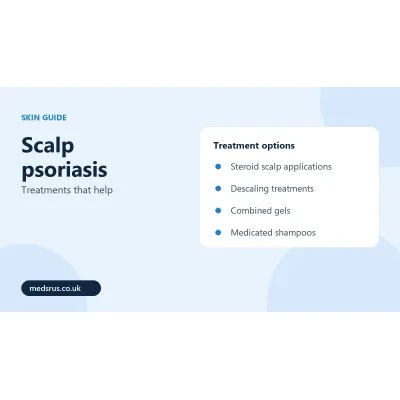
Around half of people with psoriasis have it on their scalp. It can range from fine scaling, like bad dandruff, to thick, crusted plaques that extend past the hairline onto the forehead, neck or behind the ears. It can be itchy, sore and embarrassing, but there are effective treatments.
Is it scalp psoriasis or dandruff?
Dandruff and seborrhoeic dermatitis usually cause fine, yellowish or greasy flakes spread across the scalp. Scalp psoriasis tends to cause raised, well-defined patches with thicker, silvery-white scale, which may extend beyond the hairline. You may also have psoriasis elsewhere, such as on your elbows, knees or nails. If you're not sure, a GP or prescriber can check.
Step 1: soften and remove scale
Thick scale stops treatments reaching the skin. Softening it first makes everything else work better.
- Apply a scalp treatment containing salicylic acid, coal tar or coconut oil, or plain olive or coconut oil, and leave it on for a few hours or overnight (with a shower cap), then wash it out.
- Gently lift loosened scale with a soft brush or comb. Don't pick or scratch, as this can make psoriasis worse.
Step 2: medicated shampoos
Shampoos containing coal tar, salicylic acid or ketoconazole can help mild scalp psoriasis or be used alongside other treatments. Leave the shampoo on for the time stated on the label before rinsing. Coal tar can stain pale or dyed hair and has a strong smell.
Step 3: prescription treatments
UK guidance from NICE recommends:
- A potent steroid, such as betamethasone, applied once a day for up to four weeks, as a scalp application, lotion, mousse or shampoo. This is usually the first prescription treatment.
- If this hasn't worked after four weeks, a different form of the treatment (for example a shampoo or mousse instead of a lotion), or treatments to remove thick scale before applying the steroid.
- A combined steroid and vitamin D-like treatment (calcipotriol with betamethasone), or a vitamin D-like treatment alone for people who can't use steroids, if the first options haven't worked.
Apply scalp treatments by parting the hair and applying directly to the plaques rather than the hair. Most steroid scalp applications contain alcohol and can sting broken skin, and some are flammable, so keep away from flames and don't use a hairdryer straight after. Check the leaflet for your treatment.
Our eczema and psoriasis treatment page includes a betamethasone scalp application and explains how a prescriber reviews your consultation.
Specialist treatment
If scalp psoriasis is severe, widespread or not responding, a GP can refer you to a dermatologist. Options include specialist scalp treatments, light therapy and tablet or injection treatments that work on the immune system.
Day-to-day tips
- Be gentle when brushing and styling, and avoid very hot hairdryers.
- Hair dye and perms can irritate an inflamed scalp. Do a patch test and avoid them during a flare.
- Hair loss can happen with scalp psoriasis, usually from scratching or removing scale. It usually grows back once the psoriasis is controlled.
- Manage general triggers such as stress, smoking and alcohol.
See a GP if your scalp is very sore, weeping or infected, if you're losing a lot of hair, or if you have joint pain or swelling. Our guide to eczema vs psoriasis explains how psoriasis differs from other rashes.
Frequently asked questions
What is the best treatment for scalp psoriasis?
UK guidance recommends a potent steroid scalp treatment once a day for up to four weeks as the usual first prescription treatment, often after softening thick scale. If that doesn't work, a combined steroid and vitamin D-like treatment may be used.
Does scalp psoriasis cause hair loss?
It can, usually from scratching or removing scale. The hair usually grows back once the psoriasis is under control.
Can I dye my hair with scalp psoriasis?
Many people can, but dyes can irritate an inflamed scalp. Do a patch test first and avoid dyeing during a flare.
How do I remove thick scale from my scalp?
Apply an oil or a scalp treatment containing salicylic acid or coal tar, leave it for a few hours or overnight, then wash it out and gently lift the loosened scale with a soft comb. Don't pick at it.
Sources: