


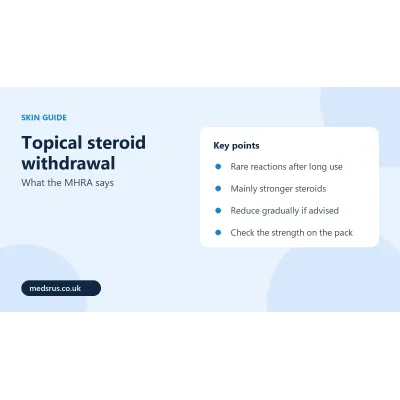
Topical steroid withdrawal (TSW) has been widely discussed on social media, and some people worry about using steroid creams at all. In 2021 the UK medicines regulator, the MHRA, reviewed the evidence and published advice. This guide summarises what it says, so you can use steroid creams with confidence.
What is topical steroid withdrawal?
Topical steroid withdrawal reactions are rare reactions that can happen after stopping a steroid cream or ointment that has been used for a long time, continuously or inappropriately. They're sometimes called red skin syndrome.
The MHRA review describes symptoms that can appear within days to weeks of stopping, including:
- redness of the skin that may extend beyond the area originally treated
- burning or stinging, which can be more intense than the original condition
- skin peeling or flaking
- in some people, oozing skin
These reactions can be hard to tell apart from a flare of the original condition, such as eczema.
Who is most at risk?
The MHRA found that reactions were mostly reported after long-term, continuous or inappropriate use of moderate to very potent steroids, often for 6 to 12 months or longer, and particularly on the face and genital area. They're not expected with short courses used as directed.
What the MHRA advises
- Topical steroids are effective and safe treatments when used correctly, and the benefits outweigh the risks for most people.
- Use the least potent steroid that works, for the shortest time needed.
- Know the strength of the steroid you're using. Packaging now shows its potency.
- If you've used a steroid for a long time, talk to your prescriber before stopping. They may suggest reducing it gradually.
- Report any suspected withdrawal reaction to your prescriber, and to the MHRA through the Yellow Card scheme.
Using steroid creams safely
- Use the amount and strength your prescriber advises. Our guide to fingertip units explains how much to apply.
- Apply only to inflamed skin, usually once or twice a day.
- Use it until the flare settles, then stop or step down as advised.
- Keep using emollients every day; they reduce how often you need steroids.
- Don't use stronger steroids on your face or genital area unless a doctor advises it.
- Get a review if you find you need a steroid most days for weeks at a time.
Don't stop treatment out of fear
Under-treating eczema or psoriasis has its own risks: longer flares, broken skin, infection, poor sleep and a big effect on quality of life. If you're worried about steroids, don't stop suddenly. Talk to your prescriber, pharmacist or GP about your concerns and your options. They can review the strength, how often you use it, and whether other treatments may help.
What to do if you think you have a withdrawal reaction
See your GP. Describe how long and how often you used the steroid, its strength and where you applied it. Your GP may refer you to a dermatologist. Get urgent help if your skin becomes widely red and inflamed, weepy or infected, or you feel unwell with a high temperature.
Our eczema and psoriasis treatment page explains the treatments we offer. Our prescribers review how long you've been using any steroid before supplying another.
Frequently asked questions
Is topical steroid withdrawal common?
No. The MHRA describes it as rare. Most reported cases followed long-term, continuous or inappropriate use of moderate to very potent steroids.
Are steroid creams safe?
Yes, when used correctly. The MHRA says topical steroids are effective and safe treatments, and the benefits outweigh the risks for most people. Use the least potent steroid that works for the shortest time needed.
Should I stop using my steroid cream?
Don't stop suddenly if you've used it for a long time. Talk to your prescriber, who may suggest reducing it gradually. Short courses used as directed can usually be stopped once a flare settles.
How do I report a reaction to a steroid cream?
Tell your prescriber or GP, and report it to the MHRA through the Yellow Card scheme online or via the Yellow Card app.
Sources: