


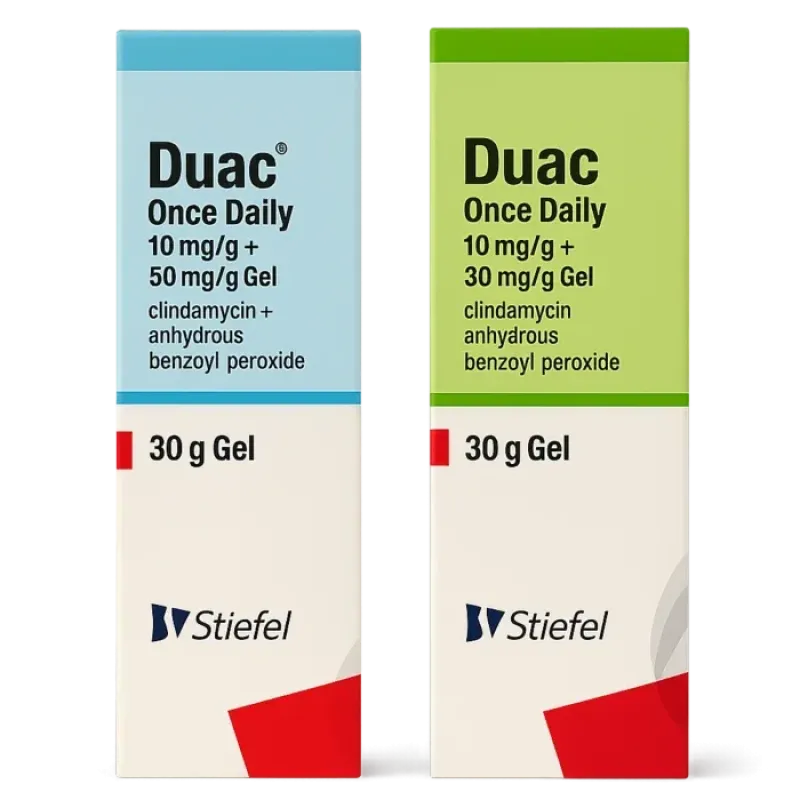
Images are for illustration only.
Duac Gel
Duac is a once-daily acne gel combining the antibiotic clindamycin with benzoyl peroxide (3% or 5%). For mild to moderate acne, especially red and inflamed spots. Prescription-only.
Free online assessment with a UK prescriber



Duac Once Daily Gel is a prescription acne treatment that combines the antibiotic clindamycin (1%) with benzoyl peroxide (3% or 5%). You apply a thin layer once a day, usually in the evening. It's used for mild to moderate acne, especially red and inflamed spots, and most people see results in 4 to 6 weeks. At MedsRus, a UK prescriber reviews a short online consultation before supplying it.
Duac at a glance
| Details | |
|---|---|
| Active ingredients | Clindamycin 1% with benzoyl peroxide 3% or 5% |
| How often | Once a day, usually in the evening |
| Time to work | 4 to 6 weeks |
| Maximum course | 12 weeks in a row, then a review |
| Bleaching | Can bleach hair and fabrics |
| Age | 12 and over |
| Prescription needed | Yes |
We also supply a generic clindamycin and benzoyl peroxide gel, which contains the same active ingredients at the same strengths.
How does Duac work?
Acne develops when oil (sebum) and dead skin cells block hair follicles, and bacteria called Cutibacterium acnes multiply inside them. This leads to blackheads, whiteheads and red, inflamed spots.
- Clindamycin is an antibiotic that reduces the acne bacteria and calms inflammation.
- Benzoyl peroxide kills bacteria and gently unblocks pores. It also lowers the chance of the bacteria becoming resistant to clindamycin, which is why the two are combined.
How to use Duac gel
- Wash the area with a mild cleanser and pat it dry. Wait until your skin is completely dry.
- Apply a thin layer once a day, usually in the evening, over the whole area where you get spots, not just on individual spots.
- Keep it away from your eyes, lips, mouth, nostrils and any broken skin.
- Wash your hands well afterwards.
- Use a sunscreen during the day, as your skin may be more sensitive to sunlight.
- Using more than a thin layer won't work faster and is more likely to irritate your skin.
Bleaching
Benzoyl peroxide can bleach hair, eyebrows and fabrics. Keep the gel away from your hairline, let it dry before it touches clothes, and use white or old towels and pillowcases.
How long to use it
You'll usually see an improvement after 4 to 6 weeks, so don't stop too soon. Don't use Duac for more than 12 weeks in a row without a review. Long courses of antibiotics, even on the skin, can make bacteria resistant.
Side effects of Duac
Most side effects affect the skin and are worst in the first few weeks:
- Common: dryness, peeling, redness, a burning feeling, itching.
- Less common: increased sensitivity to sunlight, a skin reaction to the gel, temporary changes in skin colour.
If your skin becomes very irritated, use the gel less often or stop and speak to us.
Stop using Duac and speak to a doctor straight away if you get severe, prolonged or bloody diarrhoea or tummy cramps, even weeks after you've stopped. Rarely, clindamycin can cause a serious bowel inflammation called colitis.
Who can't use Duac?
Duac is for adults and young people aged 12 and over. Don't use it if you:
- are allergic to clindamycin, lincomycin, benzoyl peroxide or any of the other ingredients;
- have had ulcerative colitis, Crohn's disease (regional enteritis) or colitis after taking antibiotics;
- are under 12.
If you're pregnant, trying to get pregnant or breastfeeding, tell the prescriber first.
Avoid using other strong or irritating skin treatments at the same time unless a prescriber has advised it. This includes retinoids such as adapalene or tretinoin, and strong acid peels.
For how Duac compares with Epiduo and Treclin, and what else can help, read our guide to acne treatment.
How to get Duac from MedsRus
- Complete a short online consultation about your skin, your health and any medicines you use.
- A UK prescriber reviews it and, if Duac is suitable, approves your treatment.
- Pay and confirm your order once it's approved.
- We send it in plain, secure packaging.
Duac FAQs
Is Duac a cream or a gel?
It's a gel (Duac Once Daily Gel), although lots of people call it Duac cream. You use it the same way: a thin layer once a day, usually in the evening, over the whole area with spots.
How long does Duac take to work?
Most people notice an improvement after 4 to 6 weeks of daily use. Don't use it for more than 12 weeks in a row without a review.
Does Duac bleach clothes?
Yes. The benzoyl peroxide in Duac can bleach hair, eyebrows, towels, bedding and clothes. Use white or old pillowcases and towels, and wash your hands after applying it.
Can I use Duac with moisturiser?
Yes. A light, oil-free moisturiser can help with dryness. Apply it after the gel has dried.
Can I use Duac while pregnant?
Tell the prescriber if you're pregnant, trying to get pregnant or breastfeeding. They'll check whether Duac or another treatment is more suitable.
Duac or Epiduo: which is better?
Neither is better for everyone. Duac combines an antibiotic with benzoyl peroxide and suits red, inflamed spots. Epiduo combines benzoyl peroxide with the retinoid adapalene, which also helps blackheads and whiteheads and has no antibiotic, so it can be used for longer. A prescriber can help you choose.
Can I use Duac on my back?
Yes, it can be used on the back and chest as well as the face. Take extra care with clothing and bedding, as it can bleach fabric.
Sources: